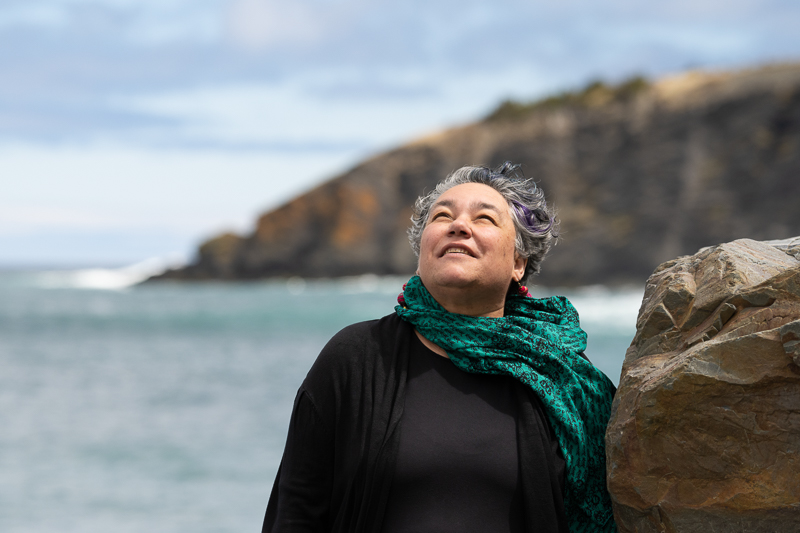
I have published fiction, creative non-fiction, poetry, and scholarly work.
Most of my literary writing has been in the area of creative non-fiction, a genre that allows me to weave my creative impulses together with my analytical and archival interests.
In 2019, I published a memoir, What the Oceans Remember: Searching for Belonging and Home (more details on that below!). I have also published shorter essays in a variety of literary journals including Riddle Fence, Geist, Room, and The Ethnic Aisle, as well as in anthologies. It has been short-listed for Room Magazine’s creative non-fiction contest (2015) and long-listed for CBC Canada Writes creative non-fiction contest (2014).
As a poet, I have published work in the Dalhousie Review, Janus Unbound, Pinhole Poetry, DarkWinterLit, and Unlost, and have a chapbook coming out with Pinhole Poetry in 2025. In 2021, I received a Newfoundland and Labrador Arts and Letters Award for poetry.
I have completed a fiction manuscript and am currently working on book-length poetry and creative non-fiction projects.
WHAT THE OCEANS REMEMBER:
SEARCHING FOR BELONGING AND HOME
“This memoir is an exploration of memory, archival documents, and the limits of both. It’s also about music, race, lineage, inheritance, and family, and I loved it. A truly extraordinary, entrancing work.”
— Kerry Clare, author of Mitzi Bytes and Waiting for a Star to Fall, and author of Pickle Me This blog.

What the Oceans Remember: Searching for Belonging and Home (WLU Press, 2019) tells a story of complicated belongings, and of a search for origins, belonging, and home.
In this memoir that traverses five continents an spans more than two centuries, I explore archives, family stories, and my memories in a question to understand the stories that lie behind my Dutch name, Canadian passport, British birth certificate, and brown skin. Along the way, I ponder the rich possibilities—but also the limitations—of archival sources, the pull of the ocean, the meanings of music, love, legacy, freedom, memory, and ruin, and ultimately, the relevance of our pasts to understanding our present.
Honours and Recognitions: What the Oceans Remember was longlisted for the BMO Winterset Award (2020) and the Newfoundland and Labrador Book Awards, received an Honourable Mention in Non-Fiction category of the Miramichi Reader’s Very Best Books (2021), and was a Finalist for two Foreword INDIE awards (2020).
Reviews
“To say that What the Oceans Remember is engrossing reading is to do it a disservice. For, here is a topic I have no real investment in. I am not of any of Ms. Boon’s mixed background, I have very little interest in ancestry and no real desire to research it by travelling back and forth across the Atlantic ocean. Yet here I was, looking over Ms. Boon’s shoulder the entire time. I was with her in the archives as she handled papers over a century old. I was with her as she travelled the historic streets in Amsterdam and The Hague, as well as the footpaths and overgrown graveyards in Suriname. Using sights, sounds and smells of the world outside her doors and windows wherever she is living at that particular moment makes for an immersive read. Many memoirists leave such things out of their reminiscences and the resulting story is the poorer for it.” (James M. Fischer, The Miramichi Reader)
“Boon’s musical training has given her an ear for subtlety in both human interaction and archival excavation for which her readers are indebted.” (Evangline Holtz Schramek, “Wayfinding in the Marginalia,” Canadian Literature)
“What the Oceans Remember is breathtaking in scope. Reaching across continents, oceans and histories, it shows us what it means to live in the shadow of freedom while unfree; how the colour of a person’s skin can determine if they are seen or invisible; how the word home can exclude; how the beauty of music can be a balm; how the invaluable quiet of an archive can quake with unearthed voices. Unrelentingly honest, sometimes harrowing, steeped in rich and startling insight, and conveyed in transparent prose – elegant as silk, tough as steel. ” (Lisa Moore, author of Something for Everyone)
“This memoir is an exploration of memory, archival documents, and the limits of both. It’s also about music, race, lineage, inheritance, and family, and I loved it. A truly extraordinary, entrancing work.” (Kerry Clare, Author of Mitzi Bytes and blogger at picklemethis.com)
“A detailed and enthralling account of finding ancestors amid archival files from around the world, the book establishes an emotional connection that spans centuries …. Boon’s writing elevates an already excellent book into a beautiful work of literature. Her language is precise and evocative, conjuring images of ocean voyages and sun-touched skin, deep longing, horrific suffering, and resilience against all odds.” (Carolina Ciucci, Foreword Reviews, September/October 2019)
“What the Oceans Remember addresses the complex and complicit question ‘Where are you from?’ by taking readers on an extraordinary trip through continents and countries, and to cities and their archives, to help us understand how the stories of our ancestors tell us something about ourselves. Boon’s exploration of the seductive spaces of the archives and the crossing of various kinds of borders brings to mind the work of Saidiya Hartman (Lose Your Mother), Maggie Nelson (The Argonauts), and complements the work of writers like Sara Ahmed as well. ” (Minelle Mahtani, University of British Columbia, author of May It Have A Happy Ending)
“What the Oceans Remember unfolds as a set of meditations—astute, self-reflexive, often powerfully moving—on what it means to have to rely on [colonial] archives to learn more about one’s ancestors, glimpsed, in many cases, at the moment of an encounter with power at its most brutalizing.” (Nadine Attewell, Small Axe Salon)
“Timely, compelling and illuminating in equal measure, What the Oceans Remember, which scrutinizes the lives and legacies of several generations of slaves and indentured labourers in Suriname, also confronts the rights and responsibilities we bear in relation to our ancestors. In this ever-questioning memoir, Sonja Boon maps emotional registers and bureaucratic statistics as honestly as she navigates theoretical currents and ethical anxiety. Weaving desire, dreams, and personal memory into the historical record, Boon succeeds admirably in making silences speak and fragments cohere in a fine example of creative non-fiction. ” (Lydia Syson, author of Mr Peacock’s Possessions)
“Fragmentation, discombobulated, and perpetually unanswered questions are not seen as a lack of rigor in research here, but as a fact of social life and how we — as researchers and as people — encounter the past at different scales, be it regional, national, kinship, and across different oceans, as is the case with Boon’s trajectory. The notion that a researcher has the capacity to reveal what the past forgot to mention to the future is confronted in an intimately lyrical matter by Boon through her difficult but beautiful journey home. Boon’s ability to engage with silence as both a conceptual and a material method of analysis positions this auto-ethnography as an important example of how to grapple with questions of the unknown in research.” (Sabrien Amrov, International Migration Review)
What the Oceans Remember is available in softcover, e-book, and audiobook directly from Wilfrid Laurier University Press. It can also be ordered by your favourite bookseller, and is available at Chapters-Indigo, Amazon.com, Amazon.ca, Powell’s Books, Waterstone’s, and Blackwell’s.
 SONJA BOON